A clear understanding of raymarching and sampling inside NerfAcc creates a strong foundation for faster NeRF training and higher-quality rendering. A structured explanation of how rays move through space, how samples are selected, and how occupancy information guides these actions helps developers optimise pipelines with confidence. A simple approach ensures that complex behaviour—like voxel skipping, adaptive step sizes, and density-aware sampling—becomes easier to apply in real workflows.
Table of Contents
Raymarching as the Core Rendering Process
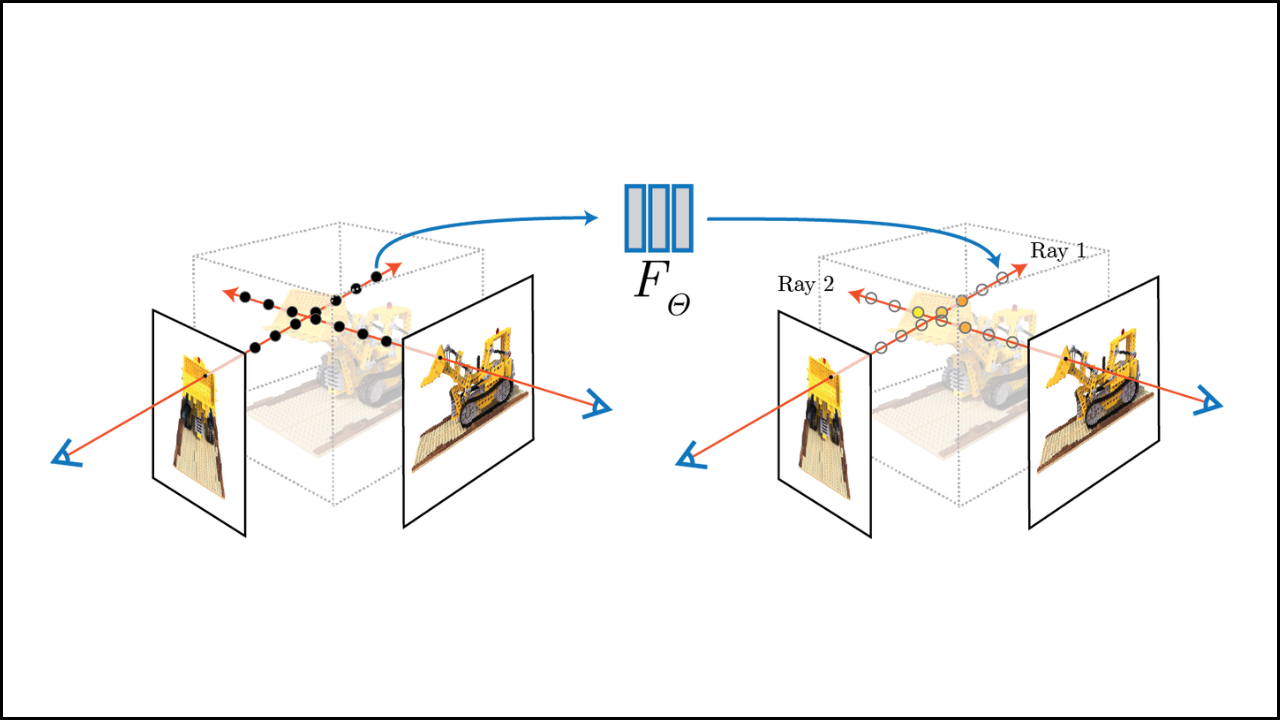
Raymarching forms the backbone of volumetric rendering in NeRF pipelines. Each pixel corresponds to a ray that travels through the scene and gathers density and colour information from sampled points.
Key contributions:
- Ray traversal moves step by step through 3D space.
- Sample points provide density and colour data.
- Alpha weights determine final pixel contribution.
NerfAcc optimises these steps by removing unnecessary traversal through empty regions.
How NerfAcc Improves Raymarching Efficiency
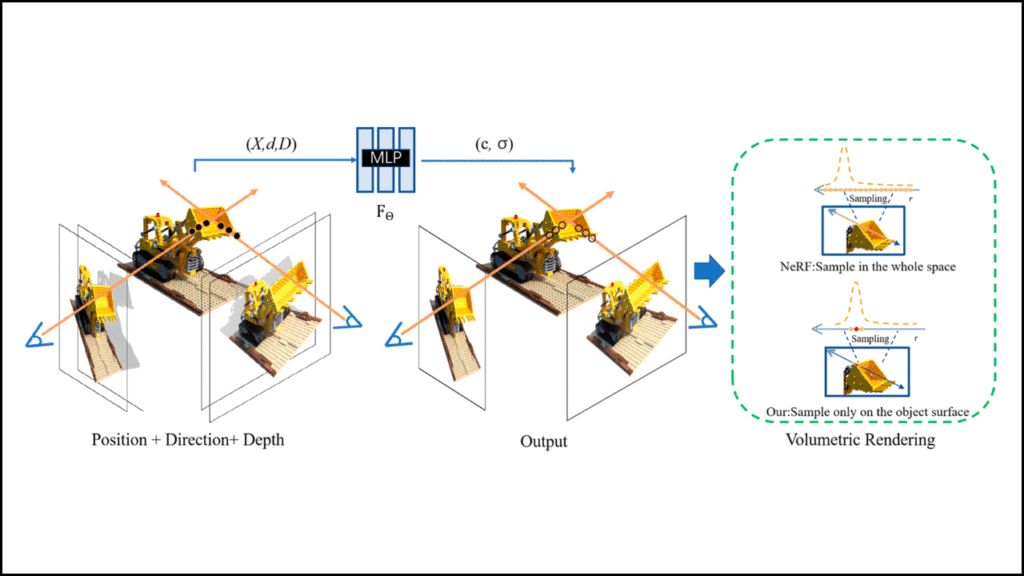
NerfAcc replaces fixed-interval traversal with an occupancy-guided approach that focuses only on useful blocks of space.
Key improvements:
- Space skipping allows rays to leap past empty voxels.
- Shorter traversal paths reduce computational load.
- Adaptive intervals adjust based on local geometry.
This refinement speeds up raymarching while preserving rendering accuracy.
Sampling as the Information Extraction Layer
Sampling determines which points along the ray are evaluated by the network.
Important aspects:
- Sample choice affects density learning quality.
- Uniform sampling wastes computation on space.
- Adaptive sampling increases detail capture and stability.
NerfAcc emphasises efficient sampling to ensure the network receives meaningful signals.
Occupancy Grids as the Decision Engine
Occupancy grids guide both raymarching and sampling by identifying which regions contain geometry.
Functions of Occupancy Grids in NerfAcc
| Function | Contribution |
|---|---|
| Empty-space filtering | Skips non-contributing voxels |
| Geometry focus | Concentrates sampling on detailed regions |
| Dynamic updates | Tracks new structures as training progresses |
| Fast voxel checks | Concentrates on detailed regions |
Raymarching Flow Inside NerfAcc
A typical NerfAcc raymarching pass includes:
- Ray-box intersection to establish valid traversal bounds.
- Voxel skipping based on occupancy values.
- Adaptive step movement as the ray travels.
- Density queries at selected sample points.
- Alpha compositing to merge colours into a pixel.
This organised flow makes the process faster and more accurate.
Sampling Behaviour: NerfAcc vs Traditional NeRF
Comparison of Sampling Methods
| Sampling Style | Traditional NeRF | NerfAcc |
|---|---|---|
| Uniform sampling | Equal spacing everywhere | Used only when required |
| Geometry-aware | Indirect or limited | Driven directly by occupancy grids |
| Ray pruning | Rarely applied | Frequent and aggressive |
| Adaptive density | Basic support | Core mechanism |
NerfAcc uses occupancy-driven sampling to capture finer details with fewer wasted computations.
Sampling and Rendering Quality Improvements
Efficient sampling plays a major role in rendering quality by ensuring that the model receives strong geometric and colour cues.
Benefits include:
- Sharper contours from dense sampling around surfaces.
- Higher colour consistency from noise-free regions.
- More accurate depth estimation due to well-placed sample points.
- Reduced artefacts like floaters or flicker.
Quality improves because the model focuses on meaningful signals.
Ray Pruning for Speed and Clean Outputs
Ray pruning allows NerfAcc to stop processing rays once they no longer contribute significantly.
Advantages:
- Faster training and rendering when rays hit empty zones.
- Cleaner volumetric integration through fewer noisy samples.
- Better overall stability in lighting and colour behaviour.
Pruning strengthens both performance and clarity.
Adaptive Step Sizes and Density-Driven Sampling
Adaptive sampling adjusts the point distribution along each ray based on the scene structure.
Adaptive Sampling Behaviour
| Region Type | Step Size Behaviour | Rendering Impact |
|---|---|---|
| High-detail zones | Small steps, many samples | Sharp edges and fine detail |
| Low-detail zones | Larger steps, fewer samples | Smooth gradients, stable colours |
| Empty zones | Steps skipped entirely | Major speed improvements |
This behaviour ensures the sampler invests resources only where they matter.
Interconnection of Raymarching, Sampling, and Rendering
Raymarching defines where rays travel, sampling chooses the evaluation points, and rendering integrates values into the final pixel. NerfAcc enhances all three.
Combined benefits:
- More accurate geometry due to adaptive sampling.
- Higher performance from efficient ray traversal.
- Better colour accuracy from clean compositing.
The coordinated optimisation delivers significant improvements in both speed and visual fidelity.
Key Takeaways
A complete understanding of raymarching and sampling in NerfAcc shows how geometry-aware traversal, adaptive sampling, and occupancy-guided pruning transform NeRF efficiency. A thoughtful integration of these techniques results in sharper images, smoother gradients, and faster training cycles. An optimised sampling-raymarching workflow ultimately allows NerfAcc to achieve high-quality rendering with minimal computational waste.