Neural Radiance Fields (NeRF) and Gaussian Splatting represent two major approaches for reconstructing and rendering 3D scenes from 2D images. The techniques share a similar goal, but their inner workings, speed, visual quality, and practical applications differ heavily. The comparison helps beginners understand why both methods are popular and how each one contributes to modern 3D vision.
Table of Contents
Apprehending NeRF
Basic Meaning
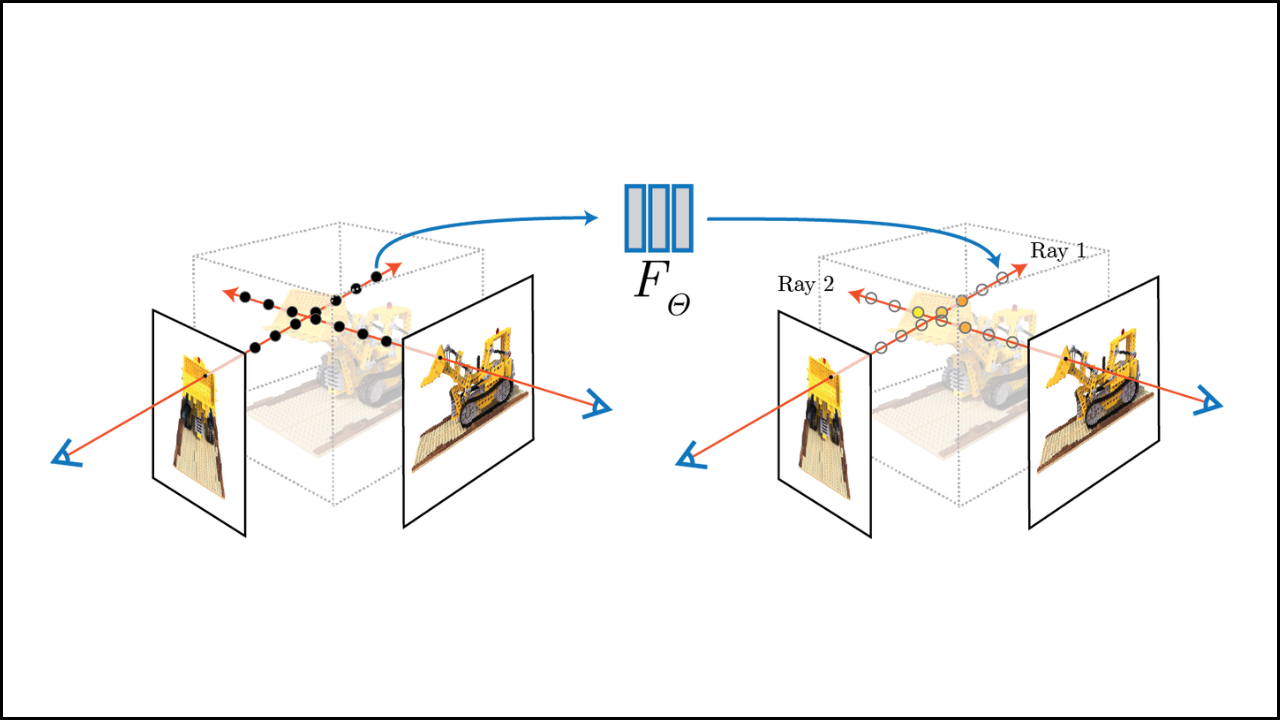
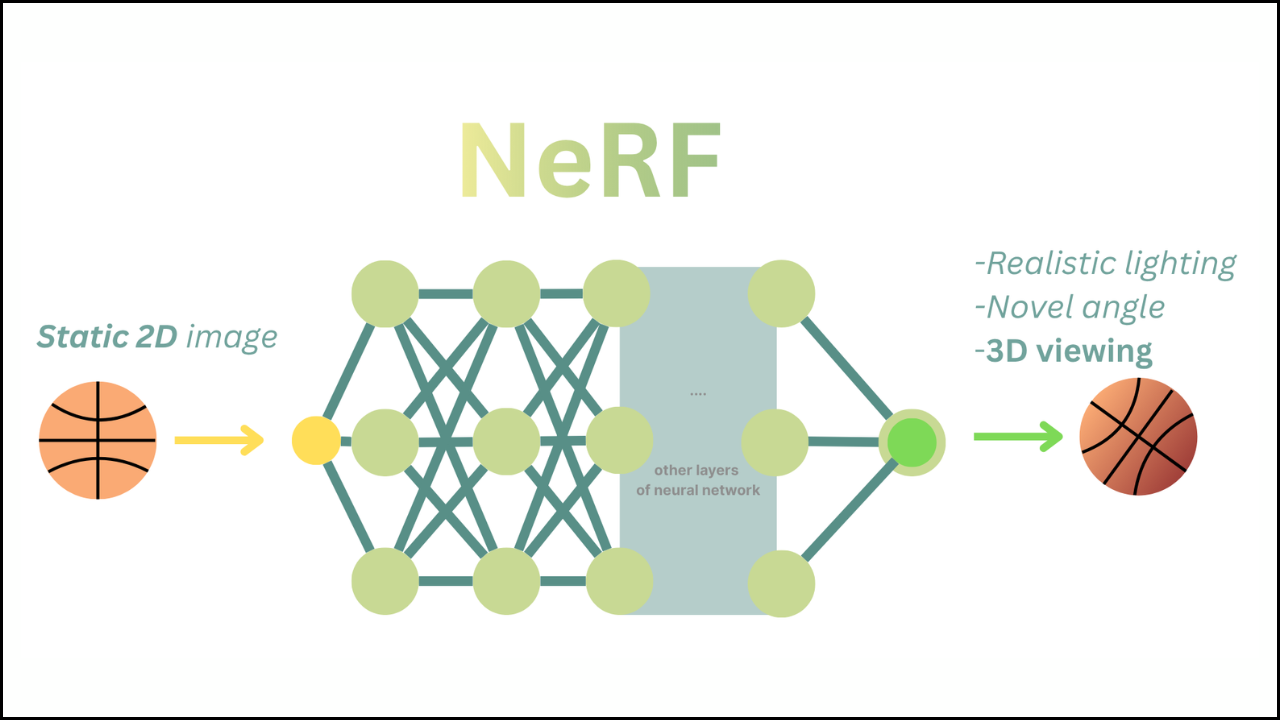
NeRF is a neural network model that learns how light behaves within a scene.
- The model takes multiple photographs as input.
- The network predicts color and density for any point in space.
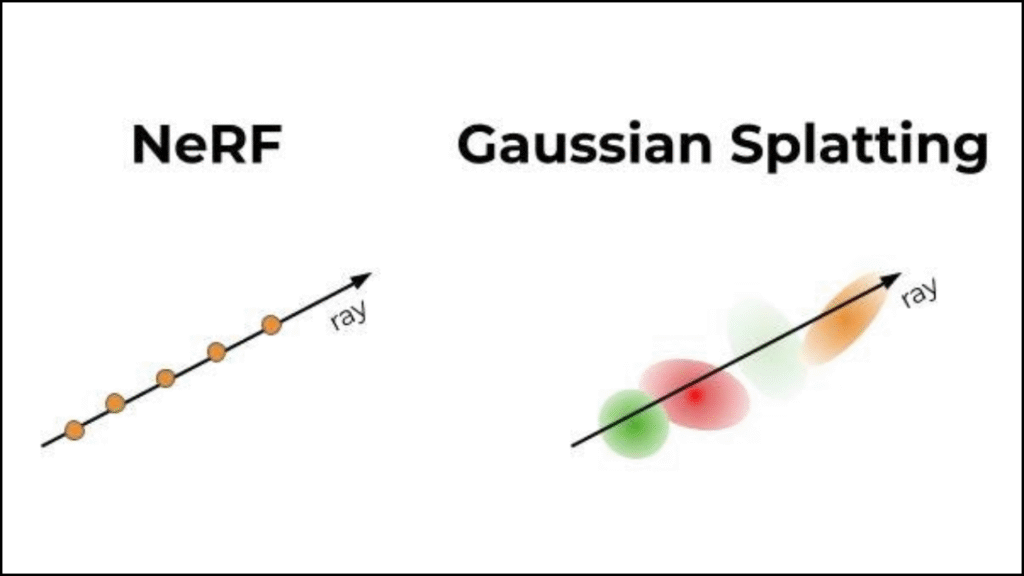
- Rays are marched through the space to compute final pixel values.
Key Strengths
- High detail: Fine textures and complex lighting.
- Smooth surfaces: Accurate geometry representation.
- Strong generalization: Works with many different types of scenes.
Common Limitations
- Slow training: Models require heavy computation time.
- Slow rendering: Ray marching makes real-time display difficult.
- Less efficient for large scenes: Memory usage increases quickly.
Understanding Gaussian Splatting
Basic Meaning
Gaussian Splatting turns a scene into thousands or millions of small 3D “Gaussian blobs.”
- Each blob stores color, position, size, and transparency.
- Rendering happens by projecting these blobs onto the screen.
- The process is fast because it avoids heavy neural-network computations.
Key Strengths
- Real-time performance: Extremely fast rendering.
- Simple representation: Works well on consumer hardware.
- Stable results: No need for heavy neural inference.
Common Limitations
- Less detailed than full NeRF in tiny, complex areas.
- Chunky appearance if Gaussians are too large or poorly optimized.
- Less effective for scenes needing very fine geometry.
Core Difference Between NeRF and Gaussian Splatting
| Feature | NeRF | Gaussian Splatting |
|---|---|---|
| Main Idea | Predicts color and density using a neural network | Uses millions of 3D Gaussian points |
| Rendering Method | Ray marching inside a density field | Projecting Gaussians onto the screen |
| Training Time | Slow | Fast |
| Rendering Speed | Slow | Real-time |
| Detail Level | Very high | Medium to high |
| Memory Use | Low during training, high during rendering | High due to storing many Gaussians |
| Best For | Research, films, high-quality static scenes | VR, games, interactive applications |
| Lighting Behavior | Very accurate | Moderate accuracy |
Why NeRF Produces High Detail
Density Fields
- Represent fine variations in shape and color.
- Capture tiny features like edges, shadows, and reflections.
Ray-Based Calculation
- Uses many samples per pixel to compute final colors.
- Produces smooth results with fewer visible artifacts.
Neural Network Power
- Learns continuous functions instead of storing fixed points.
- Enables infinite resolution for some regions of the scene.
Why Gaussian Splatting Is Fast
Point-Based Representation
- Removes the need for deep neural inference during rendering.
- Uses only the mathematical projection of points.
Efficient GPU Usage
- Works excellently with GPU parallelization.
- Ideal for real-time engines and VR headsets.
Direct Optimization
- Gaussians store color and transparency directly.
- No expensive lookup or interpolation needed.
Practical Advantages of Each Method
| Category | NeRF Advantage | Gaussian Splatting Advantage |
|---|---|---|
| Speed | Higher quality results | Real-time interaction |
| Geometry | Smooth and continuous | Good for large open scenes |
| Hardware Needs | Higher compute required | Works on modest GPUs |
| Editing | Difficult to edit the NeRF structure | Easy to add, move, or delete Gaussians |
| Use in Games | Less suitable | Perfect for real-time gameplay |
| Use in Film | Cinematic-quality detail | Fast previews and layout |
Where NeRF Works Best
Film and VFX
- High-detail scenes with complex lighting.
- Environment reconstruction for cinematic shots.
Scientific Visualization
- Accurate representations of density fields.
- Useful for medical scans and research.
Cultural Preservation
- Detailed 3D documentation of monuments and artifacts.
Where Gaussian Splatting Works Best
Virtual Reality
- Real-time rendering helps maintain high frame rates.
- Smooth interaction with 3D spaces.
Gaming
- Fast rendering integrates easily with game engines.
- Great for background environments and mid-range scenes.
Mobile and Web
- Lightweight rendering works well on limited hardware.
When to Choose Which Method
| Scenario | Best Choice | Reason |
|---|---|---|
| Need extreme detail | NeRF | Continuous neural fields capture rich textures |
| Need real-time performance | Gaussian Splatting | Fast point projection |
| Rendering on mobile devices | Gaussian Splatting | Lower hardware demands |
| High-end VFX | NeRF | Accurate lighting and shading |
| Interactive 3D tours | Gaussian Splatting | Smooth navigation |
| Academic research | NeRF | More control over physical light modeling |
Future Trends
Hybrid Techniques
- Many researchers are now combining NeRF and Gaussian Splatting.
- Models aim to keep NeRF’s detail with Gaussian Splatting’s speed.
Improved Compression
- New methods reduce memory usage for both approaches.
- Large scenes will become easier to store and transmit.
Better Real-Time Techniques
- GPUs and AI accelerators may enable real-time NeRF rendering.
- Gaussian Splatting may gain enhanced lighting and shadow modeling.
Looking Ahead
NeRF and Gaussian Splatting represent two different but complementary paths in modern 3D reconstruction. NeRF focuses on detail, smoothness, and realistic lighting, while Gaussian Splatting focuses on speed, efficiency, and real-time rendering. Both methods advance 3D vision in unique ways, and future systems will likely combine strengths from each to deliver even more powerful scene representations.