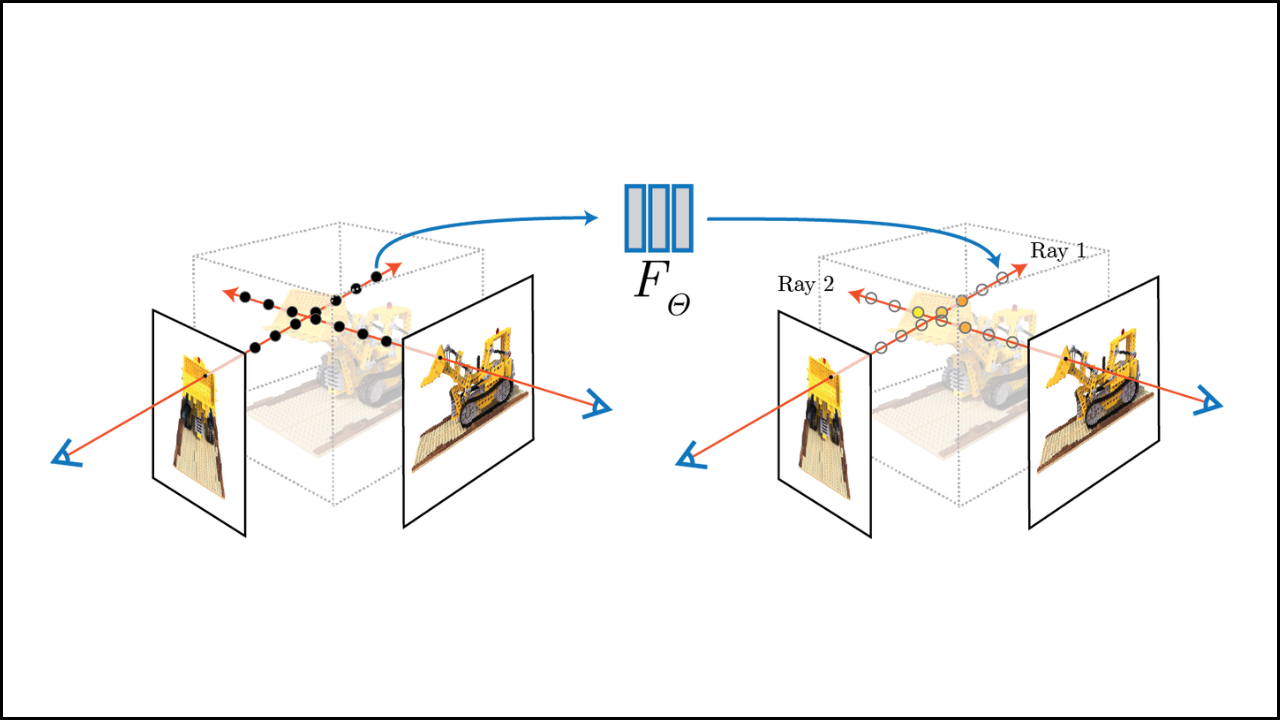
Efficient sampling within a NeRF pipeline creates a more stable path toward sharper outputs, smoother gradients, and accurate scene reconstruction. A precise sampling strategy ensures that rays concentrate on meaningful geometry rather than on irrelevant empty regions. A thoughtful explanation of how sampling choices influence density estimation, colour prediction, and training consistency helps developers understand why sampling quality directly shapes rendering quality.
Table of Contents
Efficient Sampling as the Foundation of Rendering Accuracy
Efficient sampling ensures that every training iteration focuses on the parts of the scene that contribute real information. A balanced distribution of samples across dense and thin structures enables more accurate density learning.
Key contributions:
- Focused ray attention on areas containing geometry.
- Reduced noise due to fewer redundant samples from space.
- Smoother gradients that guide the network toward stable convergence.
Efficient Sampling and Its Impact on Scene Reconstruction
- Better structural detection occurs when sampling density increases around meaningful surfaces.
- Finer edges and contours emerge due to well-distributed shading points.
- More accurate depth prediction arises from reliable density estimation.
- Stable appearance consistency improves when the sampler honours scene geometry.
Sampling Efficiency and Colour Fidelity
- Cleaner RGB prediction results from eliminating noisy points that distort colour learning.
- Better illumination modelling occurs when rays focus on surfaces that truly interact with light.
- Consistent shading behaviour reduces artefacts such as flickering or grain.
How Sampling Quality Influences Colour Output
| Sampling Attribute | Effect on Colour |
|---|---|
| Ray concentration on surfaces | Improves hue consistency and sharpness |
| Reduced empty-space sampling | Eliminates colour noise in flat regions |
| Accurate density estimation | Strengthens shading and light–surface interaction |
| Balanced sample distribution | Produces stable colour gradients |
The Relationship Between Efficient Sampling and Training Stability
A stable sampling strategy reduces variance across batches, producing cleaner gradients. Smooth training behaviour helps the network learn consistent density fields, improving both rendering speed and quality.
- Lower variance creates predictable updates.
- Better convergence leads to fewer ghost artefacts.
- Improved batch uniformity prevents colour instability.
Efficient Sampling and Neural Field Generalisation
A well-structured sampler ensures that the radiance field generalises across different camera poses and novel viewpoints.
- More reliable visibility mapping enhances accuracy for unseen views.
- Improved multi-view consistency builds a coherent 3D representation.
- Stronger geometric cues arise from clustered samples around true surfaces.
Generalisation Improvements Through Efficient Sampling
| Improvement Area | Result of Efficient Sampling |
|---|---|
| Novel view reconstruction | Produces sharper, stable images |
| Depth continuity | Smoothes transitions between surfaces |
| Scene-wide coherence | Reduces ghosting and floating artefacts |
| Fine-detail recovery | Captures thin structures accurately |
Efficient Sampling and Noise Reduction
Noise reduction plays a major role in rendering quality. Efficient sampling filters out unnecessary points that contribute no meaningful signal.
- Lower sampling noise improves brightness uniformity.
- Clearer surface boundaries appear without jitter.
- Reduced flicker enhances video-style rendering.
- Higher SNR strengthens network predictions across dense areas.
Balancing Sampling Density for Optimal Rendering
Efficient sampling does not mean sampling less—it means sampling smartly. A balanced density ensures that complex areas are sampled thoroughly, while simple or flat regions receive fewer samples.
- Adaptive density preserves accuracy in intricate areas.
- Scene-aware adjustments help tune sample counts for diverse structures.
- Balanced computation reduces training time without harming visual output.
Balanced Sampling vs Rendering Performance
| Sampling Strategy | Rendering Quality Impact | Performance Effect |
|---|---|---|
| Uniform dense sampling | Moderate accuracy, high noise | High computation cost |
| Sparse sampling | Loss of detail in thin structures | Faster but unreliable |
| Efficient adaptive sampling | High detail, low noise | Optimal training balance |
The Role of Occupancy Grids in Efficient Sampling
Occupancy grids serve as guides that help the sampler focus on relevant areas.
- Voxel-based filtering removes rays from empty zones.
- Geometry awareness lets the sampler prioritise dense areas.
- Regular updates allow the system to adapt as the model learns new scene details.
Efficient Sampling and Volumetric Rendering Quality
Sampling directly influences how densities and colours merge during compositing. Better samples produce better weights, which determine how final pixels appear.
- Cleaner alpha weighting generates sharp boundaries.
- Stable integration eliminates artefacts in complex lighting conditions.
- Accurate transmittance leads to more realistic occlusion and transparency.
Practical Improvements Observed With Efficient Sampling
- Sharper edges due to precise geometry detection.
- Better texture clarity from higher-quality shading inputs.
- Reduced artefacts in both training and final renders.
- Higher PSNR and SSIM scores in quantitative evaluations.
Final Thoughts
Efficient sampling strengthens rendering quality by directing computational effort toward meaningful regions, improving geometry detection, colour consistency, depth prediction, and multi-view stability. A structured sampling approach reduces noise, enhances fine detail, and leads to cleaner volumetric integration. A well-designed sampling strategy ultimately enables NeRF systems to deliver sharper and more reliable results across both still images and dynamic scenes.