A clear understanding of NeRF begins with the idea that a computer can learn how light behaves inside a 3D scene. A Neural Radiance Field (NeRF) is a method that uses a neural network to recreate a full 3D environment using a collection of 2D images. A short explanation of how NeRF works helps beginners understand why it is being used in graphics, robotics, gaming, and virtual reality today.
Table of Contents
What Is NeRF?
- NeRF stands for Neural Radiance Field.
- NeRF is a technique that turns ordinary 2D photos into a realistic 3D scene.
- NeRF learns how light, color, and geometry interact inside that scene.
NeRF in Simple Terms
- Imagine taking many photos of an object or room from different angles. NeRF uses these photos to understand what the scene looks like from every direction.
- Imagine the scene filled with millions of invisible points. NeRF learns the color and density of each point.
- Imagine shining a virtual flashlight through the scene. NeRF uses physics-inspired math to decide what color the camera should see.
How NeRF Works (Simple Explanation)
1. Input: Multiple Photos
- NeRF needs many images taken from different viewpoints.
- Each image comes with camera position information.
2. Scene as a Continuous Field
- NeRF does not store the scene as a mesh or voxel grid.
- NeRF treats the scene as a continuous mathematical function.
- For any 3D point, NeRF predicts:
- Density (where the surface is)
- Color (what the point looks like)
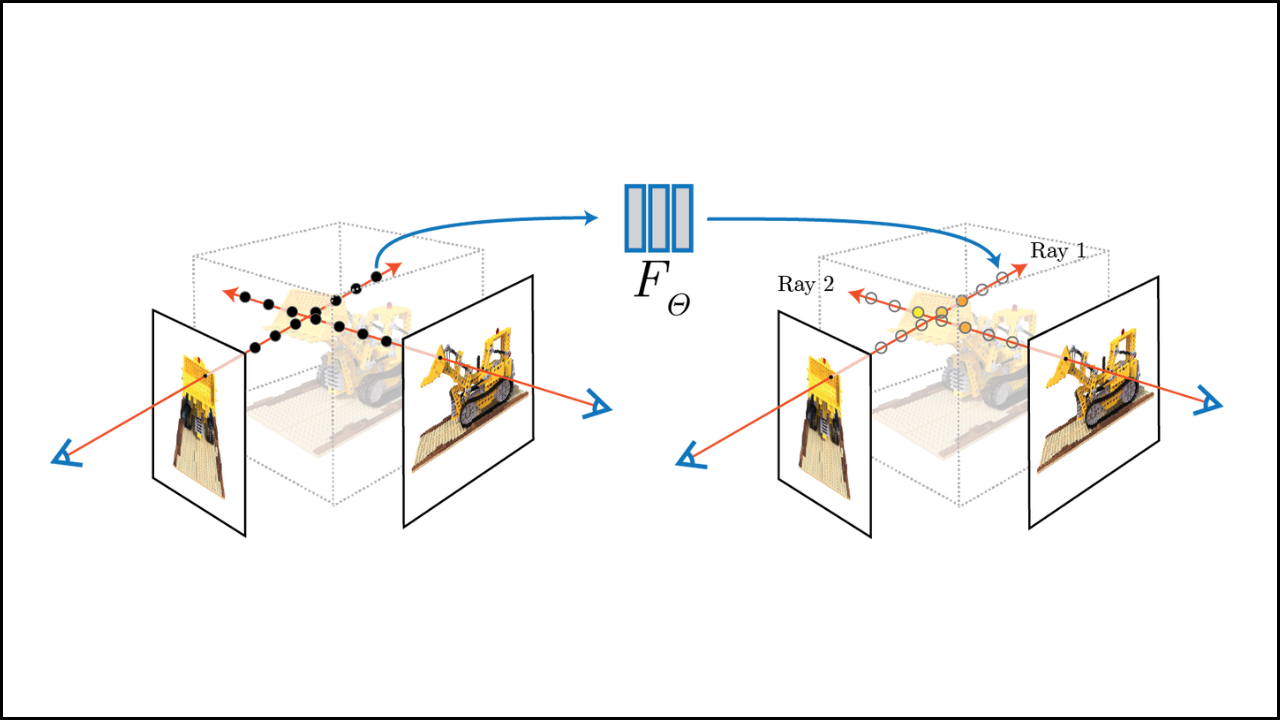
3. Rays Through the Scene
- NeRF imagines rays going from the camera into the scene.
- Each ray samples small points along its path.
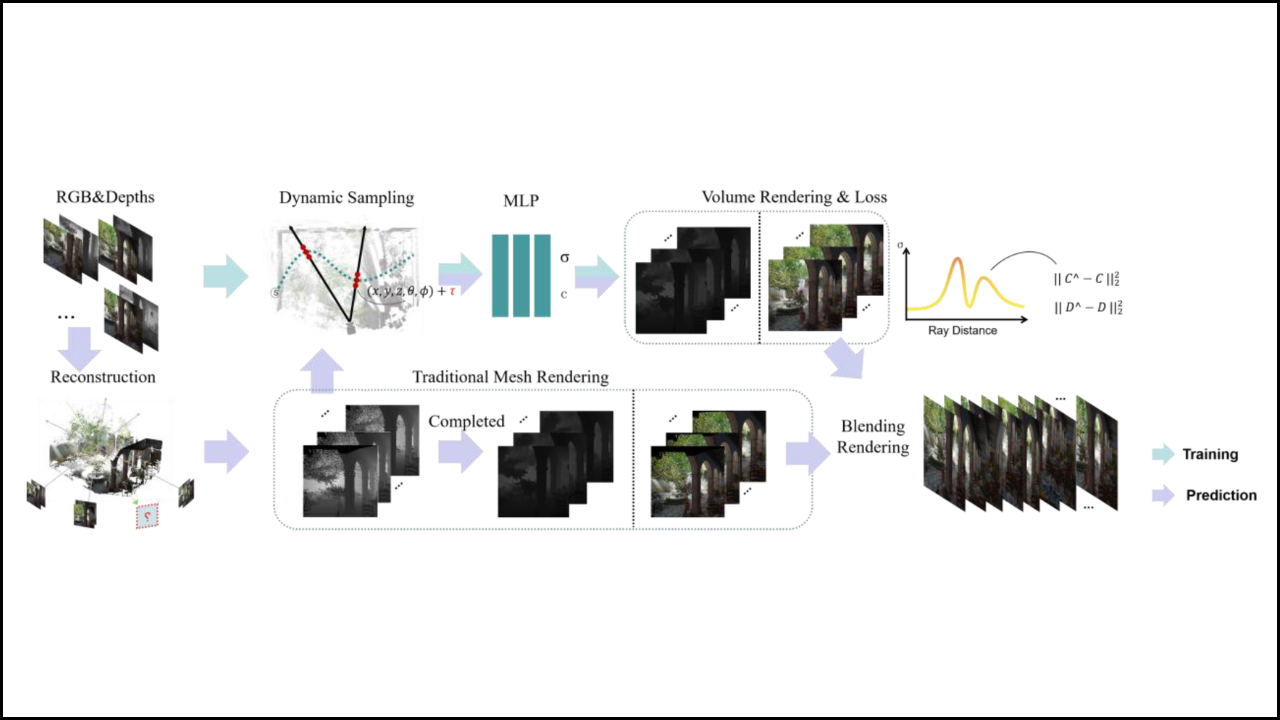
- The neural network predicts the color and density for each point.
- These predictions are combined to form the final pixel color.
4. Rendering New Views
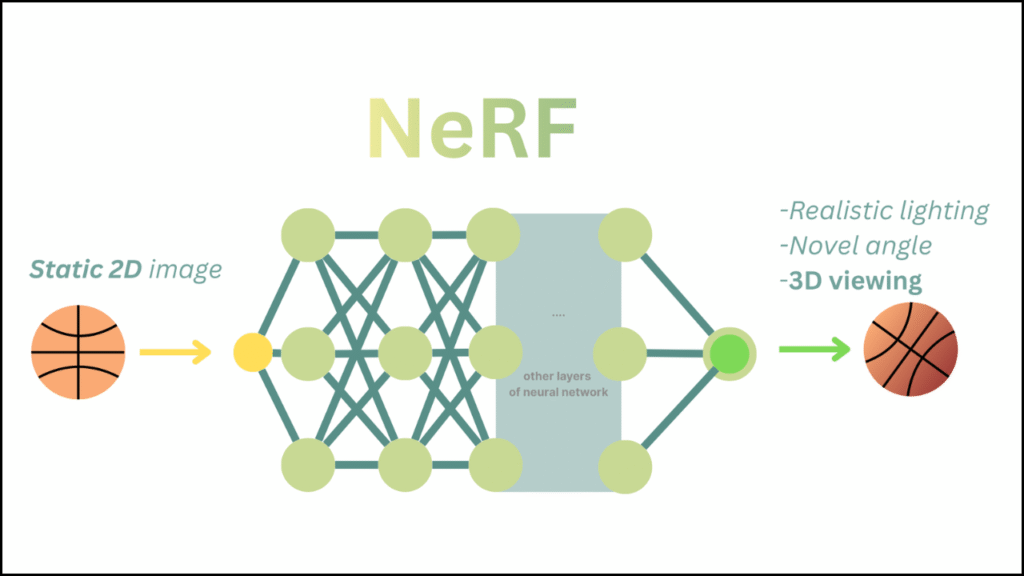
- Once trained, NeRF can generate images from viewpoints never seen before.
- This makes NeRF powerful for:
- Virtual tours
- 3D reconstruction
- VR environments
- Movie visual effects
Why NeRF Is Special
- Realistic Results: NeRF captures soft lighting, reflections, and tiny details better than many older 3D methods.
- Smooth Geometry: NeRF does not create blocky or jagged surfaces like voxel methods.
- View Synthesis Ability: NeRF can create new camera angles even if those angles never existed in the original photos.
- Compact Representation: A full 3D scene can be stored inside a relatively small neural network.
Where NeRF Is Used
- Movies and VFX are used to reconstruct environments quickly.
- Games for realistic scene reproduction.
- Robotics to help robots understand 3D environments.
- VR/AR to create immersive virtual spaces.
- Heritage Preservation to capture historical structures digitally.
- Real Estate to generate 3D walkthroughs from standard images.
Advantages of NeRF
- High realism for lighting, color, and textures.
- Smooth interpolation between viewpoints.
- Data efficiency because it learns from photos instead of needing 3D scans.
- Continuous representation for detailed geometry.
Limitations of NeRF (Simple Facts)
- Training takes time compared to classic 3D modelling.
- Rendering can be slow without acceleration tools like NerfAcc.
- Requires multiple images for best quality.
- Struggles with fast movement if the scene changes a lot.
Simple Metaphor to Understand NeRF
Think of NeRF like a painter who studies a room from many angles. The painter memorizes how each corner, shadow, and object looks under the light. Once the painter understands it completely, the painter can draw the room from any viewpoint— even one never seen before. That is exactly what NeRF does using neural networks.
Summing Up
A simple view of NeRF shows a tool that learns how a full 3D scene looks using only 2D images. A neural network predicts light and color at every point in space, allowing the computer to recreate new views with striking realism. A basic understanding of how NeRF samples points and renders pixels explains why it is becoming important in graphics, VR, robotics, and digital imaging.